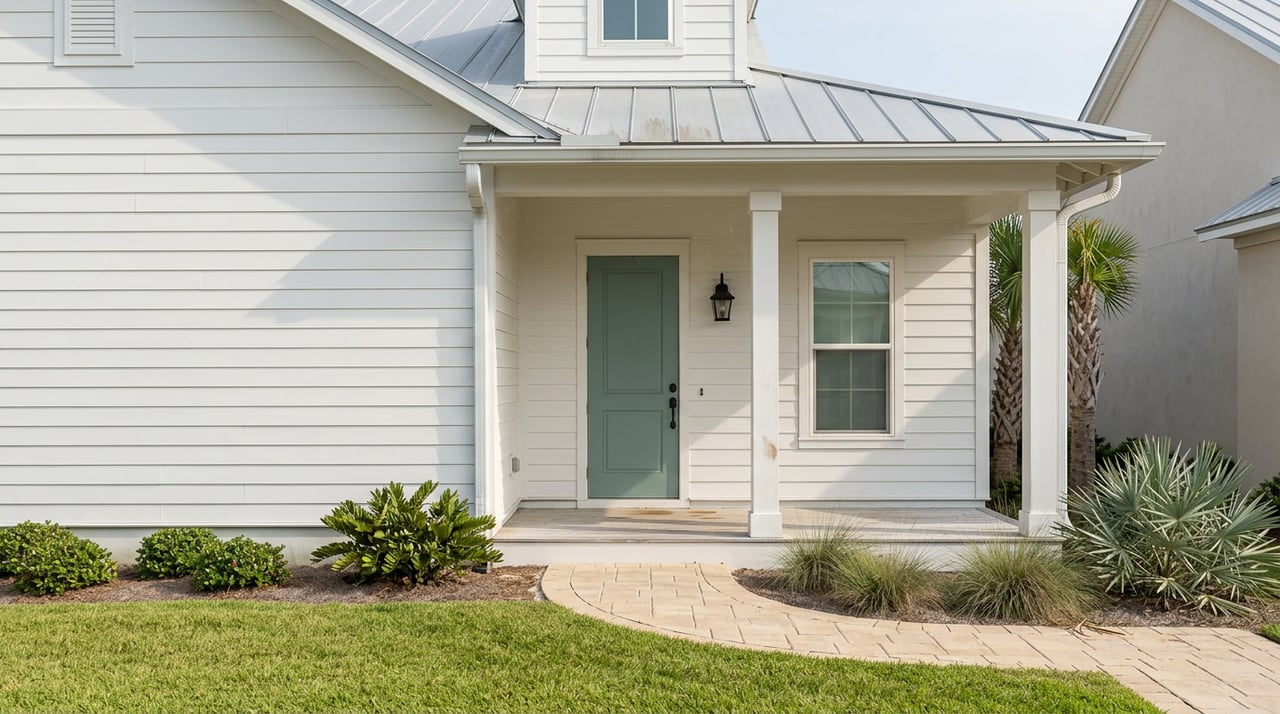
Scroll through active listings at Latitude Margaritaville and you'll notice something reassuring: the estimated taxes look manageable. A cottage in the $400s shows a monthly tax estimate that barely dents the budget next to the HOA fee. For a buyer moving down from New Jersey or Connecticut, that number can feel like proof the math works.
It's also, in almost every case, not your number. It's the seller's.
Two Owners, Same House, Two Very Different Tax Bills
Florida's Save Our Homes amendment caps how fast a homesteaded property's assessed value can climb. Once you have your homestead exemption in place, the county can raise your assessed value by no more than 3 percent a year, or the change in the Consumer Price Index, whichever is lower, no matter what happens to the home's actual market value. Volusia County's Property Appraiser applies this rule the same way every county appraiser in Florida does: it's a constitutional cap on the government's yardstick, not on the price a buyer will actually pay.
That cap resets the moment the home changes hands. Under Florida Statute 193.155(3), a property is reassessed at full market value as of January 1 the year after a change in ownership. The seller's years of capped growth don't transfer with the deed. If someone bought their Latitude Margaritaville home new in 2019 and has lived there since, their assessed value has been quietly falling further and further behind what the home would sell for today. Their tax bill reflects 2019's Florida. Yours will reflect 2026's.
Why This Hits Every Single Listing Here Now
This gap exists everywhere in Florida, but it matters more at Latitude Margaritaville than at almost any comparable community right now, for one specific reason: there's no new construction left to compare against.
Minto Communities sold out all 3,763 homes here by May 2025, more than five years ahead of the original build-out projections. The sales center is closed. Every home on the market today, from the Conch Cottages to the Island Collection, is a resale carrying someone else's assessment history. In a still-building community, a buyer can shop new construction and resale side by side and see the base-year number clearly. Here, that comparison point doesn't exist anymore. The gap between the seller's number and your number is baked into every listing you'll look at.
It matters even more because of who's buying. The community has drawn heavily from New York, New Jersey, Connecticut, and Pennsylvania. Buyers coming from those states are, by definition, arriving without a Florida homestead exemption of their own, which means the one tool that could soften the reset isn't available to most of the people shopping here.
The Three-Year Arc of Your Own Tax Bill
The reset doesn't happen all at once. It unfolds over a few tax years, and knowing the sequence helps you model your actual carrying cost instead of guessing at it.
| Timing | What happens to your assessment |
|---|---|
| The calendar year you close | The home is still assessed under the seller's number for that year's bill. Taxes are typically prorated between buyer and seller at closing. |
| January 1 the year after you close | The county resets the assessed value to full market value, generally close to your purchase price. If you've owned and occupied the home as your permanent residence since before that January 1, you can file for your own homestead exemption by March 1 and remove up to $50,000 from that reset value. |
| The tax year after that | This is the first year the 3 percent Save Our Homes cap actually starts protecting your new assessment from further increases. |
So a purchase that closes in mid-2026 rides out the rest of that tax year on the seller's number, resets to something close to your purchase price for the 2027 tax bill, and only begins earning its own cap protection starting in 2028.
To put a number on it: Volusia County's typical effective tax rate for a homesteaded primary residence runs roughly 0.9 to 1.0 percent of assessed value. On a hypothetical $500,000 purchase, after the standard $50,000 homestead exemption, that first fully-reset tax year lands in the neighborhood of $4,000 to $4,500, separate from the HOA fee, which currently runs somewhere in the $340 to $450 a month range depending on whether you're in a cottage, villa, or single-family collection. That's a real number to build a budget around. The seller's current bill isn't.
The Portability Most Buyers Here Don't Have
There's one legitimate way to soften this reset, and it's worth knowing whether it applies to you before you assume it doesn't.
Florida's portability provision lets someone who already holds a Florida homestead exemption transfer up to $500,000 of their accumulated Save Our Homes benefit to a new Florida homestead, as long as they establish the new homestead within three tax years of leaving the old one. If you're already living in Port Orange, New Smyrna Beach, or anywhere else in Florida with homestead in place and you're considering a move to Latitude Margaritaville, this could meaningfully soften your reset. You'd still lose the seller's specific capped number, but you'd bring your own accumulated benefit with you rather than starting from zero.
If you're arriving from out of state, portability has nothing to transfer. You're not choosing between a bigger or smaller benefit. You're simply the first homestead this parcel has seen from you, and the reset applies in full.
What to Verify Before You Write an Offer
A few concrete steps turn this from an abstract mechanism into a number you can actually plan around.
- Pull the parcel for any home you're seriously considering on the Volusia County Property Appraiser's site and look at the assessed value history, not just the current tax bill. A long gap between assessed value and market value is a signal, not a warning sign, but you want to know it's there.
- Run your actual intended purchase price through the county's tax estimator rather than accepting the listing's tax figure at face value.
- Ask directly whether the home carries a Community Development District assessment. Sources on this vary, with some describing Latitude Margaritaville as CDD-free and others noting a CDD line item tied to specific sections of the community. Don't guess either way. Confirm it in writing with the Volusia County Tax Collector or the HOA before closing, since a CDD assessment shows up as a separate non-ad valorem line on the tax bill and won't be captured by the homestead math above.
- Confirm your own timeline for occupancy and homestead filing. Owning and occupying the home as your permanent residence before January 1 is what starts your own exemption clock, and the March 1 filing deadline is a hard one.
Quick Questions
Does Latitude Margaritaville have a CDD? Accounts differ, which is exactly why it's worth confirming per home rather than assuming a community-wide answer. Ask the Tax Collector's office to pull the specific parcel before you write an offer.
If I'm moving from another Florida home, does portability erase the reset? No, but it helps. Portability transfers your accumulated Save Our Homes benefit, up to $500,000, to reduce your new assessed value. You still won't inherit the seller's specific capped number, but you're not starting from a bare reset either.
When will I actually feel the higher tax bill? Usually the tax year after you close, once the county reassesses to market value as of the following January 1. Your own exemption can apply that same year if you've already moved in by then, but the 3 percent growth cap doesn't kick in to protect you until the year after that.
If you're comparing Latitude Margaritaville against other Volusia County communities and want the real, all-in monthly number rather than the one printed on the listing sheet, that's exactly the kind of homework worth doing before you write an offer, not after. Geri Davis works this corridor daily and can help you run the actual math on a specific address, HOA tier included, before you fall for the number on the page.